The subway that ran on wind
In 1870 a magazine editor dug a tunnel under Broadway without quite telling anyone, and blew New Yorkers through it with a fan.
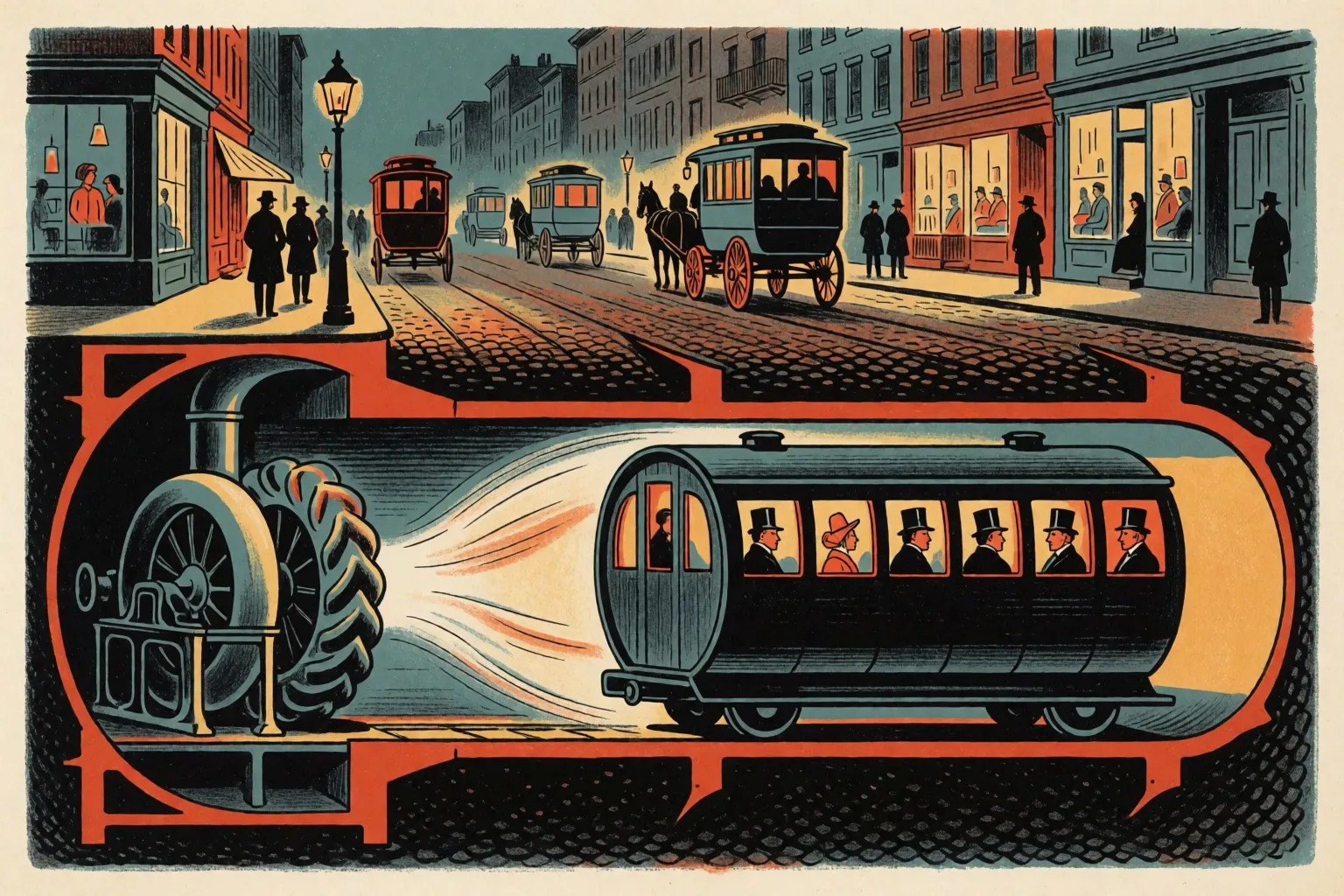
Broadway in the 1860s was choked. Omnibuses, carts and carriages locked wheels from kerb to kerb, and a man in a hurry got out and walked. Alfred Ely Beach, who edited Scientific American, decided the answer was under it.
His idea was a pipe. Put a car in a tube it fits like a cork, blow air in behind it, and the car goes. No locomotive, no smoke in the tunnel, no horses. He showed a wooden version at the American Institute Fair in 1867 and carried visitors up and down a hall in it.
A permit for parcels
Getting leave to dig up Broadway was another matter, so Beach asked for something smaller. His charter allowed pneumatic tubes for parcels and letters. In 1869 an amendment let him build one large tube in place of two small ones. He took that to mean large enough for people.
Work began in the basement of Devlin’s clothing store at Broadway and Warren Street. The men cut forward behind a round iron shield that Beach had designed, pushed ahead by hydraulic rams about sixteen inches at a time, and bricked the tunnel behind it. The digging took 58 days, most of it done at night, and the spoil went out through the cellar. To check they were on line, they drove a rod up through the roadway after dark.
Opening day
On 26 February 1870 Beach invited the press downstairs. They found a waiting room 120 feet long with frescoed walls, paintings, a grand piano and a fountain with goldfish in the basin, lit by zircon lamps. Beyond it was a white-painted tunnel and a single round car with upholstered seats. Reports of the day give it 18 seats; later accounts say 22.
The wind came from a Roots blower built in Connersville, Indiana, which the staff called the Western Tornado. A 100-horsepower steam engine turned it. The pressure behind the car was low, about a quarter of a pound to the square inch, but spread over the end of an eight-foot car that made a push of roughly three-quarters of a ton. The car rolled a block to Murray Street. Then the blower was reversed and sucked it back.
The charter said nothing about fares, so the 25 cents was called admission and went to a home for the orphans of soldiers and sailors. Over 400,000 rides were taken in the first year.
Why it stopped at one block
Beach wanted to run the line to Central Park. The legislature passed his bill in 1871 and again in 1872, and both times Governor John Hoffman vetoed it. The usual telling puts William “Boss” Tweed behind the vetoes, because Tweed had money in a rival elevated scheme. That may be so. The vetoes are on record and Tweed’s hand in them is not.
A new governor signed the bill in 1873. A few months later the Panic of 1873 closed the banks to any scheme of the kind, and the money could not be raised. The tunnel was shut. For a time it was let out as a shooting gallery and then as a wine cellar.
Beach died in 1896. In February 1912 workmen digging the Broadway subway for the BMT broke through a brick wall and found his tunnel, the shield still at its face and the rotted frame of the car on the rails. The new line took the same ground, and City Hall station now stands where the tunnel was. The shield was given to Cornell University, which has since lost it.
Sources
- nycsubway.org: Beach Pneumatic Transit (reprints the 1870 Scientific American and New York Times reports)
- Scientific American: The first subway in New York City was a cylindrical car pushed by air
- American Heritage (1961): Alfred Ely Beach and his wonderful pneumatic underground railway
- Wikipedia: Beach Pneumatic Transit