Paris kept time by pipe
For nearly fifty years one building sent a puff of air under the streets every minute, and thousands of clocks moved their hands together.
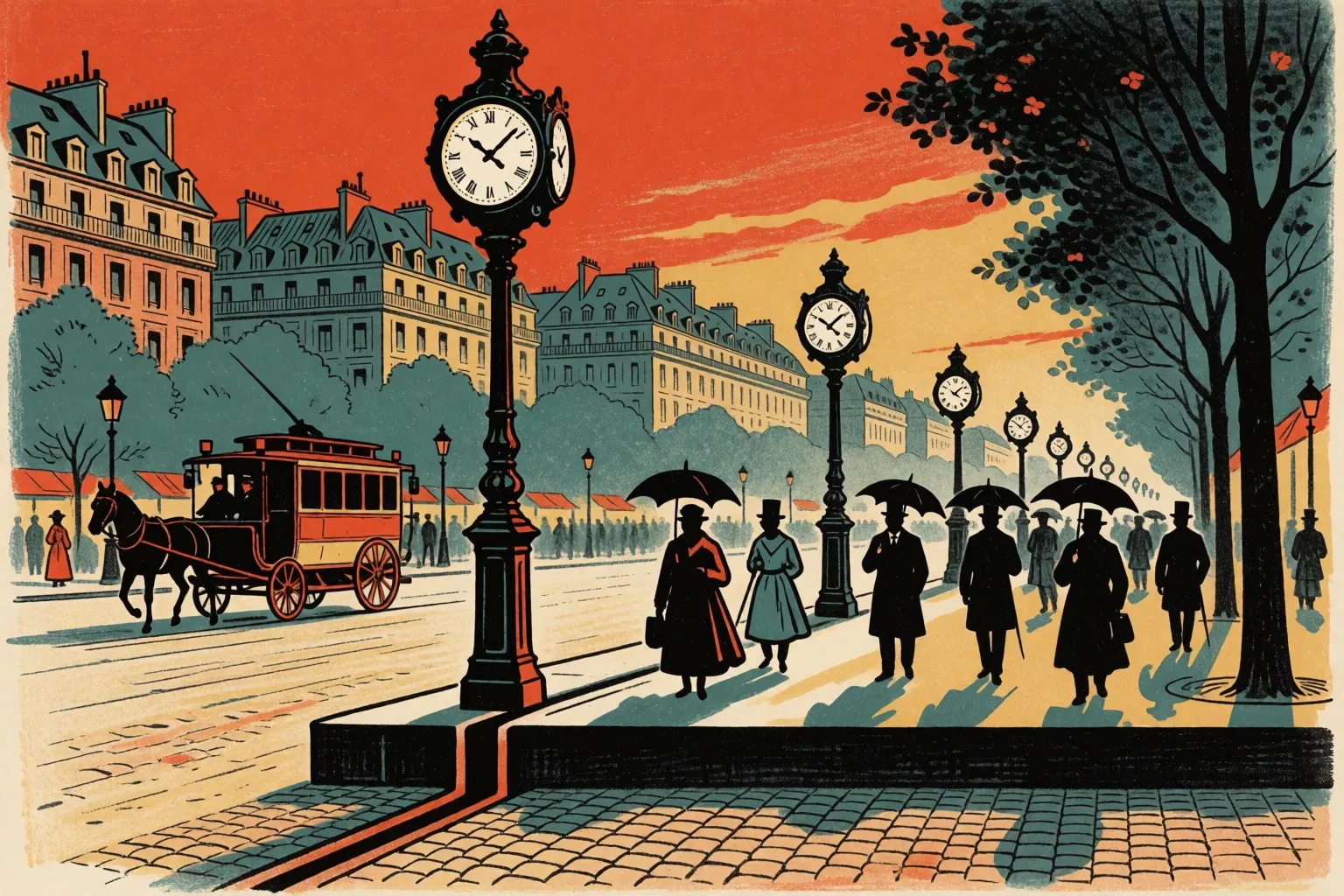
A city of two million people in 1880 had no agreed time. Every clock was wound by hand and set by guess, and two clocks on the same street could be five minutes apart. That mattered more each year, because trains, telegrams and the stock exchange all ran to the minute.
Paris fixed it with plumbing.
The idea came from Vienna
The system was the work of Carl Albert Mayrhofer, who had a small network running in Vienna in 1877. Two Austrian promoters, Victor Popp and a partner named Resch, took up his patent and showed it at the Paris Exposition of 1878, where it won a silver medal. The city gave them leave to lay ten kilometres of pipe in the sewers of the first and second arrondissements.
On 15 March 1880 four clocks on lamp-posts along the grands boulevards began to move together. By the end of that year there were 14 street clocks and 33 more in public buildings. A year later the company counted about 4,000 clocks in 750 houses.
How a clock ran on air
At 7 rue Sainte-Anne steam engines pumped air into a reservoir. A master clock opened a valve once a minute. Air went out into ten iron mains for twenty seconds, then the valve shut and the pipes emptied for forty.
At the other end, each clock had no spring and no pendulum. It had a little bellows. When the pulse arrived the bellows rose and a pawl pushed a wheel of sixty teeth on by one tooth, and the minute hand jumped. The pressure at the clock was under one atmosphere. Nobody had to wind anything.
Subscribers paid by the size of the dial. The Hôtel Meurice had 148 pneumatic clocks and paid as much for its time as for its water. The lead tubes that fed them were painted to match the wallpaper.
What grew out of it
Popp saw that pipes which could carry a pulse could also carry power. In 1886 he got leave to sell compressed air for motors, and in 1888 opened a far bigger plant at rue Saint-Fargeau. Paris workshops ran lathes, sewing machines, printing presses and lifts from a tap in the wall. That network outlived everyone who built it: it had nearly 10,000 customers in 1960 and was not shut down until 1994.
Popp himself was pushed out by his bankers in 1892.
The morning the clocks stopped
In January 1910 the Seine rose over its quays. On the 21st the water reached the compressed-air plant in the thirteenth arrondissement and the engines stopped. Across Paris the public clocks halted on the same minute. A press photograph of one of them shows the hands a little before eleven, and the usual telling gives the time as 10:53 in the morning. We have not found an official record of the minute.
The clocks were started again, but electric time signals were cheaper and needed no pipes. The service closed in 1927.