The railway with no engine
Brunel ran trains along the Devon coast with nothing pulling them but a pipe and the weight of the air. It lasted less than a year.
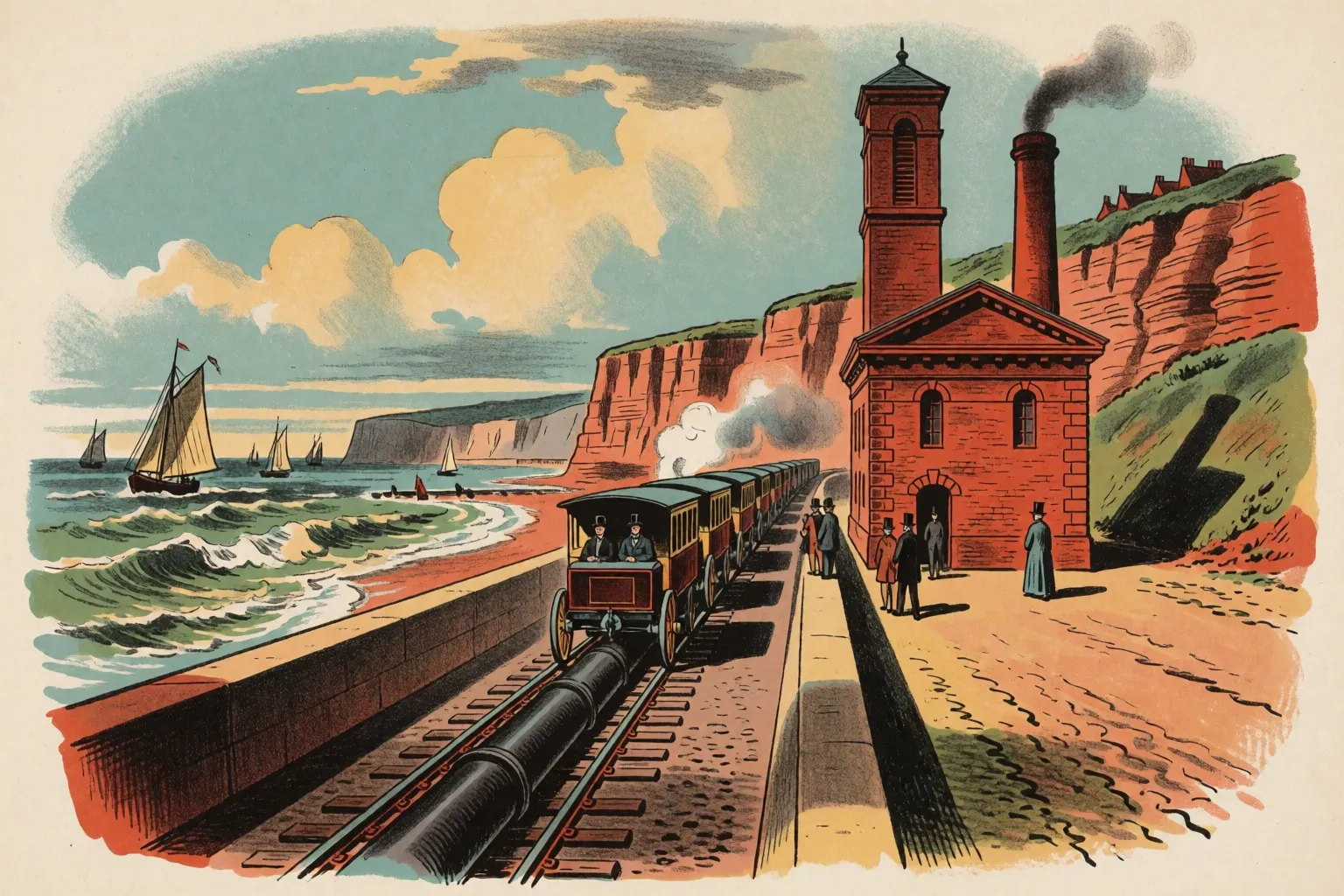
Passengers at Exeter in the autumn of 1847 boarded a train that had no locomotive. There was no smoke, no cinders in the eyes and very little noise. The train simply began to move, and before long it was running beside the sea at forty miles an hour.
What moved it lay between the rails: a cast-iron pipe fifteen inches across, with a slot along the top.
A piston twenty miles long
The system was patented in 1838 by Samuel Clegg and the brothers Jacob and Joseph Samuda. A short line at Dalkey, near Dublin, had used it since 1843. Brunel went to see it and came away convinced. Hills were the argument. A locomotive has to drag its own weight up every gradient; here the engines stayed in sheds beside the line, and the train carried only itself.
Every three miles or so stood an engine house with an Italianate chimney, and in it a pair of steam engines that pumped the air out of the pipe. Under the leading carriage hung a piston, inside the pipe, joined to the carriage by an arm that passed through the slot. With the air drawn out in front and the atmosphere pressing behind, the piston was driven forward and took the train with it.
The whole scheme rested on the slot. It was closed by a strip of leather riveted between iron plates and hinged along one edge. Wheels on the piston lifted the flap ahead of the arm, and another wheel on the carriage pressed it shut behind. Grease made the seal.
It worked
Public trains began running between Exeter and Teignmouth on 13 September 1847, and to Newton in January 1848. The service was fast and mostly punctual. On test, a 28-ton train averaged 64 miles an hour over three miles, and a 100-ton train managed 35.
There were awkward corners. The pipe could not pass through points, so at some stations trains were hauled out by a rope from a smaller pipe beside the track, and elsewhere horses did the shunting. Where a road crossed the line a hinged iron plate covered the pipe, and rose when the air was drawn out.
The leather
The flap spoiled it. In the winter of 1847 the leather soaked up rain and froze stiff. In the hot summer that followed it dried and cracked. By May and June of 1848 lengths of it were tearing away from their fixings. Air leaked in along the line, and the engines had to burn far more coal to hold the vacuum: three shillings and a penny-halfpenny a train-mile, where a shilling had been forecast.
There is a well-known story that rats ate the leather for its tallow. Nobody has found a record of it in Devon. The rats belong to an earlier atmospheric line at Croydon, where a naturalist wrote in 1859 that they crept into the pipe at night to eat the grease.
Replacing the valve from end to end was priced at £32,000, and Samuda would not pay. In August 1848 Brunel told the shareholders the system should be given up. He did not hide behind anyone:
I have no hesitation in taking on myself the full and entire responsibility for recommending the adoption of the atmospheric system in the South Devon Railway…
The last atmospheric train, a goods, reached Exeter half an hour after midnight on Sunday 10 September 1848. Locomotives took over. The company had spent £433,991 and recovered about £81,000 by selling off the equipment.
What is left
The engine house at Starcross still stands beside the line and is now a fishing and cruising club; it served about ninety years as a chapel first. Two more that were built and never used survive at Torquay and Totnes. Three lengths of the larger pipe meant for the hills west of Newton turned up at Goodrington in 1993, where they had been buried as a drain. They are laid out on broad-gauge track at Didcot Railway Centre.