The iron man who never took a step
A 22-year-old machinist in Newark patented a steam-powered man to pull a carriage. It barely worked, and it started a whole kind of story.
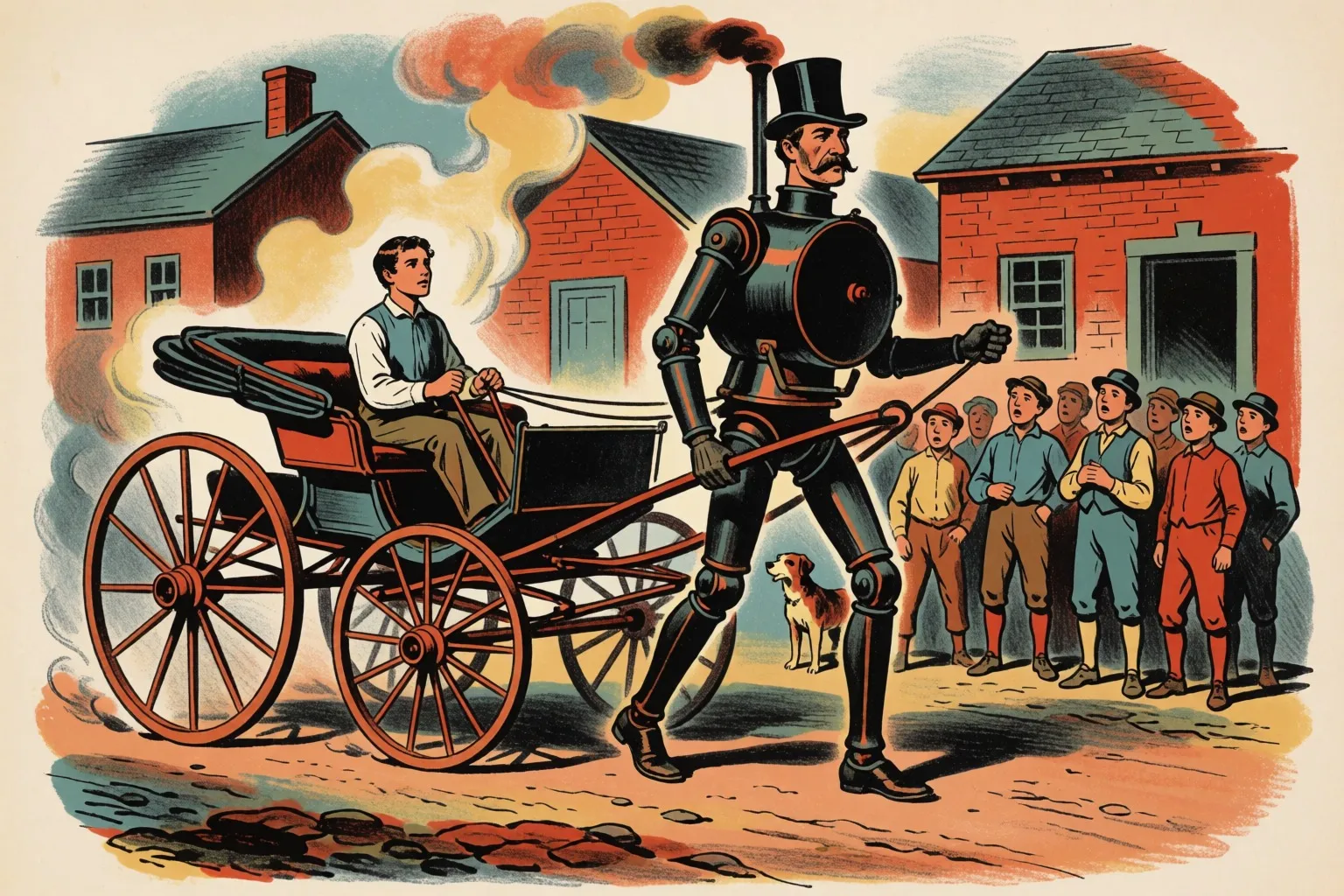
In January 1868 the Newark Advertiser sent a reporter to look at a man made of iron. He stood seven feet nine inches tall and weighed five hundred pounds. He wore, the paper said, “pantaloons, coat and vest, of the latest styles”, and had “a cheerful countenance of white enamel”. His stovepipe hat was sheet iron and let out the smoke.
His maker was Zadoc Dederick, a machinist of twenty-two, helped by a younger man named Isaac Grass. They had spent $2,000 on him.
What was inside
The chest held a boiler, padded with felt and wool so the suit would not scorch. Below it sat a three-horsepower engine that drove the legs through cranks. The Steam Man could not balance. He stood between two iron shafts fixed to a carriage, as a horse stands in harness, and the carriage held him up and carried the driver, the water and the coal.
Dederick gave him a human shape for a reason: the idea was that a horse would not shy at a man, where it would bolt from an engine. He told the paper the legs could turn fast enough for “a little over a mile a minute”, though he meant to run at half that. Once in production a Steam Man would sell for $300, “warranted to run a year without repair”. The patent was granted on 24 March.
What it actually did
Crowds paid to see him at Crump’s Garden in Newark and then at 538 Broadway in New York. What they saw was less than the posters promised. Scientific American went along and reported that the figure was “hung in slings and merely ‘marks time’”. He was not allowed to walk across the hall under steam, and there is no good account of him walking anywhere else.
He was taken on tour: Boston, Chicago, Philadelphia, St. Louis, New Orleans. By September 1869 he was advertised for sale. A New Jersey paper is said to have called him a “grievous humbug”. In April 1870 he was reported in store, held against an unpaid freight bill. After that the record stops.
The part that lasted
Elsewhere in New Jersey lived Edward S. Ellis, a schoolteacher who wrote cheap novels at great speed. In August 1868, five months after the patent, Beadle published his The Steam Man of the Prairies. A boy inventor builds a ten-foot steam man and drives it west to fight and prospect. It is generally counted as the first American science-fiction dime novel, and it was reprinted six times.
In 1876 a rival publisher answered with Frank Reade and His Steam Man of the Plains, which ran for years and added steam horses, airships and submarines. Critics later gave the whole family a name, the Edisonade: a young inventor, a marvellous machine, a frontier to try it on.
That is the line that steampunk comes down from. It begins with a machine that hung in a sling on Broadway and paddled its feet.